Brewer J.C. Jacobsen`s Portrait Award
Special Prize: Jan Neva
The jury a Special Prize to the Finnish artist Jan Neva with
the following citation:
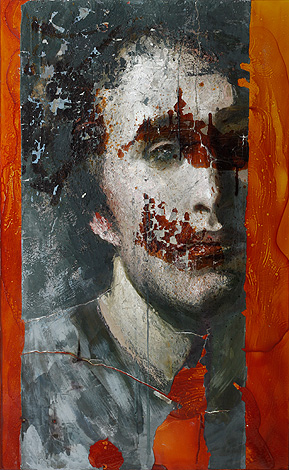
The portrait of the Finnish artist Jan Neva ‘Faust’ arrests the viewer’s attention immediately. Is it a portrait or a philosophical meditation? What does the artist want to tell us? What message does this powerful image bring us? Is it a warning? A beautiful and sad gentle face is slightly turned from full face against monochrome uneven grey background with dark red margins on both sides. It forces to stop, it magnetizes. The more you look at the portrait the more it penetrates your consciousness. He seduces and attracts with his young beauty full of tragic notes. His perfect and harmonious features are fretted with bloody red stains of decomposition.
The artist relegates us back to an ancient example dating back to the Coptic period of the Roman rule of Egypt, to portraits the majority of which was found in the necropolis of Faiyum. In late 1st century BC or the early 1st - 3rd century they represented a traditional part of a burial cult and intended to cover faces of the deceased. They were painted on panels made of cedar, sycamore or cypress of elongated vertical shape. The artists mostly used encaustic (wax) painting well preserved in hot dry Egyptian climate, retaining their bright glossy colours. These portraits sometimes suffered of heavy deep vertical cracks in their wooden support.
Jan Neva copies neither the technique nor the materials of the classical art blindly. Instead of wood and encaustic, he uses aluminium support and modern paints. His colour scheme is based on the contrast of grey and bright red. His loaded brush stokes are full of dramatic energy. Blood-tingled staining on the face, brown-red margins and vertical cracks do not imitate but associate with damaged panel and at the same time with existential drama. The artist needs a dialogue between old Roman and modern art to demonstrate the eternal theme of human existence with its dramatic duel of good and evil. Based upon the highly naturalistic images of the Fayium portraits he came to more abstract and possibly even more expressive and impressive art. The painter’s method is not straightforward, it induces on viewer’s unconscious. The title ‘Faust’ is a message in itself that could be interpreted differently. One of the old stories about Dr. Faust tells that when he was found dead his face and body were covered with terrible bruises and blood stains, and one of his eyes was gouged. Deliberately or just by chance, but this is what the artist depicts here, or how the stains and cracks, covering the surface of the painting could be explained. Possibly, Neva’s painting speaks about evil’s destructive force that lives inside a human who sold his soul for pleasures of the world, or, perhaps, about the evil that lives in everyone. It depends on us only whether this force finds its way out and in what form.
Born in 1974 Jan Neva has graduated The Imatra School of Art (1993) and obtained his Master of Arts degree from The Finnish Art Academy (2000). In 2001-2003 Neva studied at The St. Petersburg Academy of Arts.
Elizaveta Renne curator at the State Hermitage Museum, St,Petersburg, Russia
|





